
A brief history of cards
Playing cards are small rectangles of thick cardboard or thin plastic used in card games. A complete set of playing cards is called a pack or deck. The cards in a deck are of the same shape and size. The cards are also used for focussing, "card reading" and more. Each card has two sides - face and back. The backs of the cards in the deck are the same and the cards are identified by their faces.
The first playing cards appeared in East Asia. In China and Korea, maps are already mentioned in the 12th century. There are also earlier references to the game in which oblong sheets were used - they refer to the 9th century of the period of rule of the Tang Dynasty (618 - 907)
Before the advent of paper maps, the Chinese and Japanese used flat oblong tablets made of wood, bamboo or even ivory. Spread across different cultures, decks take on different shapes and forms. In India they played with round cards called ganjifa. In medieval Japan during the Shogunate, the card game Uta-garuta was popular, which used seashells as a deck depicting scenes from poems, life and the seasons.
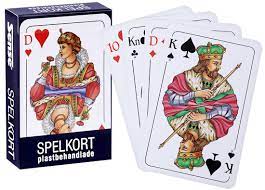 There is no exact data on how the cards reached Europe. It is assumed that the distribution path of playing cards is China - India - Persia - Egypt - Europe. The first mentions of playing cards in Europe date back to the 14th century. There is an entry in the chronicle of the city of Bern from 1367 that reports the banning of cards. In 1370, the word naipes (playing cards) appeared in a Spanish book of poems.
Here is another interesting presentation of the cards.
- The 52 cards represent the 52 weeks of the year.
- The two colors red and black are day and night.
- The 4 suits are the 4 seasons of 13 weeks each – the cards from each suit.
- Twelve main cards represent the 12 months.
- If we add up all the cards (Ace + two + three...etc.) we get 364 - the days of the year.
The card game is a calendar that tells us about the weeks, months and seasons of the year. Each season begins with a week of Pops, followed by a week of Queens, Jacks, etc., until the season changes to Ace and a new suit begins - a new season. Jokers are used in leap years.
Tarot
The cards we use today have a common root with the Tarot cards. The Egyptian version of the origin of the cards is very popular. Occultists claim that in ancient times Egyptian priests recorded all the wisdom of the world on 78 golden tablets, which are also depicted in the symbolic form of cards. 56 of these - the "Minor Arcana" - became ordinary playing cards, and the remaining 22 "Major Arcana" became part of the mysterious Tarot deck used for divination. This version was presented for the first time in 1785 by the French occultist Ettteil, and his successors, the Frenchmen Eliphas Levi and Dr. Papus and the British Mathers and Crowley, create their own systems for interpreting tarot cards. The name comes from the Egyptian "ta rosh" ("the way of the kings"), and the cards themselves were brought to Europe either by Arabs or Gypsies, who are often thought to have come from Egypt.
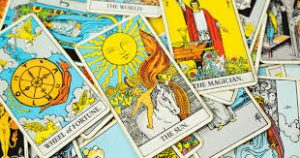 Cups, diamonds, spades and spades are the result of a random selection for the four colors. The original colors date back to the Middle Ages and were divided into 4 types, as with Tarot cards today - cups, coins, wands and swords. Over time, they evolved into the colors we see today.
Each of jacks, queens or jacks looks completely different, and that's because they're based on real historical figures. The design originated in France, where playing cards were extremely popular among the aristocracy during pre-revolutionary times.
- Pop Spades K♠ – King David
- Pop Cup K♥ – Charlemagne
- Pop Caro K♦ – Julius Caesar
- Pop Spatia K♣ – Alexander the Great
- Queen of Spades D♠ – Goddess Athena Pallas and sometimes Joan of Arc
- Queen of Hearts D♥ – Helen of Troy and the biblical Judith
- Lady Caro D♦ – the biblical Rachel
- Lady Spatia D♣
- Vale Pica IN♠ – Holger the Dane (Oger the Dane) and Count Roland
- Vale Cup IN♥ – the French knight La Guerre, by nickname Satan.
- Vale Caro IN♦ – Hector, leader of the Trojan army and the Frankish Count Roland, general under Charlemagne
- Vale Spatia IN♣ – Lancelot Lake, first knight of King Arthur, in love with his wife Guinevere (Lady of Clubs D♣)
Over time, the list of prototypes varied considerably: different masters painted maps with different names of kings, among them Solomon, Octavian Augustus, Constantine the Great and Clovis /for the Riga royal map K (king) or R (roi)/.
 For many centuries there has been fierce debate about the exact meaning of the symbols depicted on the Tarot cards. In all probability, no two opinions exist as to the exact meaning of these symbols. Cabalists, temple priests, and countless mystical secret societies, characterized by serious internal disagreements, give the cards such complex and nebulous interpretations that they prove difficult to apply to the average individual. The meaning given to the cards by the gypsies often turns out to be completely opposite to the interpretation that can be found in ancient books of an esoteric nature.
Oracles
Unlike Tarot, Oracle decks have as many cards as the author/creator decides. Different decks have different purposes. They are mainly for fortune telling, but there are exceptions. Some modern oracle decks are more for meditation. The most famous and popular oracle decks for divination are Lenormand, Kipper cards and Gypsy cards. They consist of 36 numbers that resemble a pattern, but it is very different from the Tarot. The exception is the Symbolon deck, which has 78 cards, but is not a Tarot, nor is it an Oracle. Its specific structure is based primarily on astrology, and the meanings of the cards are more psychological. It can be used alone or in combination with a Tarot or Oracle deck, but the Symbolon deck itself is not for divination.