From "Once upon a time - manners and worldview of the Bulgarians" (see in the Shop)
On this day, the church honors the memory of the Holy Apostles Peter and Paul. Both the Catholic and Orthodox churches honor them together and consider them the pillars of Christ's teaching and some of the most zealous followers of Jesus.
Christian legends
Peter's birth name was Simon. He was a fisherman with a violent temper. It was Jesus who gave him the name Peter (stone) when Simon converted to Christianity. His brother Andrew, the first disciple of Jesus, took him to the Master. According to legends, God also gave him the keys to the heavenly kingdom. Peter was the first Pope and founder of the church.
 Paul was born with the name Saul. Originally from the city of Tarsus, Saul was a follower of Judaism and a staunch opponent of Christians. Since, in addition to being a Jew, he was also a Roman citizen, as an inheritance from his father, he also had a Latin name: Paul (Paulus), which meant "humble". One day, on the way to Damascus, Jesus appeared to him and Saul was blinded by God's insight. He heard the words: "Saul, Saul, why are you persecuting Me?". His companions brought him back to the city, where in three days a miracle happened and he regained his sight. He became one of the most zealous propagators of the Christian religion. He preached outside the Jewish community, mainly in Macedonia and the White Sea, reaching as far as Sipania, which is why he was called the "apostle of the Gentiles". One version is that the two apostles were crucified together by Emperor Nero in AD 67.
Folklore collection "Once upon a time - manners and worldview of the Bulgarians"
Folk beliefs
This holiday coincides with the most intense period of the economic life of the Bulgarian. At this time of the year, the first apples - petrovki - are ripening. In popular belief, people honor St. Peter on June 29, and St. Pavel – on June 30. In some regions of the country, June 30 is known as Palm Sunday and is associated with burning, with fire. There is no strict prohibition against working on St. Peter's Day, but even preparing food is prohibited on Pavlov's Day. In order not to anger the saint and have him set fire to the fields and spoil the flour, people did not do any economic activity. The biggest prohibition was to light a fire, neither outside nor in the hearth.
 On St. Peter's Day, St. Peter's chicken is slaughtered for Kurban. Holiday pie, butter and cheese pie and pumpkin cake were also part of the feast. The symbol of the rooster here comes from paganism – a solar sign of the higher, the heavenly, which, like the sun, measures time and is a symbol of resurrection. And the Christian meaning of the holiday is firmness (like a stone - Peter) and humility (Paulus - humble, modest). The holiday is especially strictly observed in families where there are deceased children. Mothers brought parsley apples and bread to the church, which were also consecrated and then distributed. In the Garden of Eden there was a golden apple tree, around which the souls of the dead children swarmed like bees. When their mothers gave out apples on Earth, St. Peter allowed them to pick fruit from the tree of paradise. Mothers, however, should not take a bite out of them. And on Pavlov's Day, the girls and women went out to the meadows, swung on swings, played rascals and sang ritual songs. In the evening, only the old and married people sat down at the festive table, and the young welcomed the sunrise.
According to popular belief, Peter is the judge of human sins and the locksmith of Heaven. He stands at the gates of heaven and welcomes the souls of the dead. He opens the big notebook where all the good and bad deeds and thoughts of people are recorded. Peter judges whether the soul is worthy of Heaven or sends it to Hell.
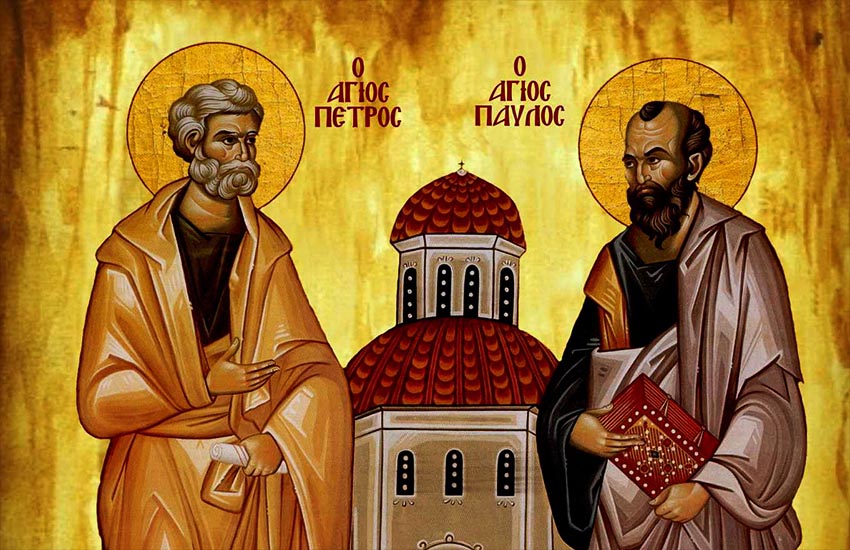
In the iconography, the two apostles are together holding a church, they are represented as the pillars of Christianity.
They celebrate a name day Peter, Pavel, Kamen, Petya, Pavlina and Polina.
© 2024 Iliana Dechkova