 Chi è Dante? - Who is Dante?
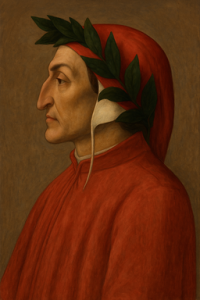
Dante Alighieri (1265–1321) is a very famous Italian poet. La sua opera più importante è 'The Divine Comedy', un poema che descrive un viaggio immaginario nell'Inferno, Purgatorio e Paradiso.
Dante Alighieri (1265–1321) was a famous Italian poet. His most important work is The Divine Comedy, a poem that describes an imaginary journey through Hell, Purgatory, and Paradise.
Cos'è l'Inferno? – What is "Hell"?
L'Inferno is the first part of the Divine Comedy. Dante viaggia traverso 9 cerchi dell'Inferno con la guida del poeta Virgilio. Each circle represents a type of sin and has a special punishment.
"Inferno" is the first part of "The Divine Comedy." Dante travels through nine circles of Hell, guided by the poet Virgil. Each circle represents a type of sin and has a specific punishment.
I nove cerchi dell'Inferno – The Nine Circles of Hell
Sins and punishments - I peccati e le punizioni
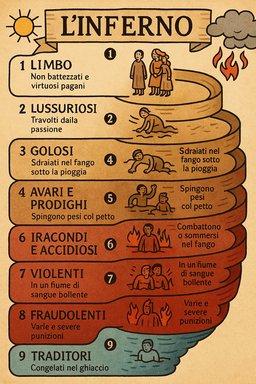
1. Limbo
-
Sin: Not baptized, virtuous pagans (e.g. philosophers, poets, children who died without baptism) – Non battezzati, pagani virtuosi (es. filosofi, poeti, bambini morti senza battesimo)
-
Punishment: Eternal sadness for the absence of God, without physical torment, living in darkness and hopelessness – Tristezza eterna per l'assenza di Dio, senza tormenti fisici; vivono nell'oscurità e nella desperazione
2. Lussuriosi
-
Sin: Fornication, lust (driven by passion)
-
Punishment: They are eternally dragged by a stormy whirlwind, incapable of peace — as passion led them in life – Trascinati eternamente da un turbine impetuoso, incapaci di trovare pace — come lo furono nella vita
3. Gluttons (Golosi)
-
Sin: Gluttony and Gluttony – Lussuria e desiderio carnale (guidati dalla passione) – Gola e ingordigia
-
Punishment: They lie in cold mud under perpetual rain and hail, torn apart by the three-headed Cerberus – Giacciono nel fango gelido sotto una pioggia e hailine incessanti, dilaniati da Cerbero a tre teste
4. Misers and Prodigals (Avari e Prodighi)
-
Sin: Greed and waste (the two extreme poles of the relationship with wealth) – Avarizia e spreco (due estremi del rapporto con la ricchezza)
-
Punishment: They collide with each other with heavy stones in a senseless and eternal struggle - Si scontrano l'un l'altro spingendo enormi massi, in una lotta eterna e priva di senso
5. Iracondi e Accidiosi (Iracondi e Accidiosi)
-
Sin: Anger and spiritual laziness (apathy, inaction) – Ira e accidia (apatia, inerzia spirituale)
-
Punishment: The angry fight among themselves in the muddy swamp of the River Styx, the lazy lie under the water, unable to express themselves – Gli iracondi si combattono nel fango del fiume Stige, gli accidiosi giacchiono sotto l'acqua, incapaci di esprimersi
6. Heretics (Eretici)
-
Sin: Heresy (denial of the immortality of the soul, false doctrines) – Eresia (negazione dell'immortalità dell'anima, false dottrine)
-
Punishment: They lie in open graves, heated by eternal fire – Giacciono in tombe aperte arroventate da fiamme eterne
7. Violenti
Divided into three sub-circles – Divisi in tre cerchi:
-
Against your neighbor (murderers, robbers) — immersed in boiling blood – Against the neighbor (omicidi, briganti) — immersi in sangue bollente
-
Against yourself (suicides) — locked in trees, torn apart by harpies – Against themselves (suicidi) — trasformati in alberi, straziati dalle arpie
-
Against God, Nature, and Art (blasphemers, sodomites, usurers) — in a burning desert, under a rain of fiery drops – Against God, nature and art (bestemmiatori, sodomiti, usurai) — nella sabbia infuocata, sotto pioggia di fuoco
8. Fraudolenti - Malebolge
Composed of 10 pits, each for a different type of fraud – Composto da 10 bolge, ognuna per un diverso tipo di frode:
-
Pimps, flatterers, corrupt, soothsayers, hypocrites, thieves, counterfeiters, etc. – Ruffiani, adulatori, simoniaci, indovini, corrotti, ipocriti, ladri, consiglieri fraudolenti, seminatori di discordia, falsari
-
Penalties: Various — boiling pitch, chained, bitten by snakes, heavy cloaks, diseases and madness – Varie — pece bollente, catene, serpenti, mantelli di piombo, malattie, follia, ecc.
9. Traitors (Traditori) – Cocito
Divided into 4 zones according to the victims – Diviso in 4 zone a seconda delle vittime:
-
Cain – betrayal of relatives – China – betrayal of parents
-
Antenora – to the homeland – Antenora – of the homeland
-
Ptolemy – to guests – Tolomea – of the guests
-
Giudecca – to benefactors (the lowest) – Giudecca – dei benefattori (la più profonda)
-
Punishment: Frozen in the icy lake of Cocytus; the greater the sin, the deeper they are frozen.
In the center - Satan with his three mouths chews Judas Iscariot, Brutus and Cassius - Congelati nel lago ghiacciato Cocito; più grave è il peccato, più in profundo sono immersi.
Al centro — Satana mastica con le sue tre bocche Giuda Iscariota, Bruto e Cassio
 Esercizio 1 – Traduci in italiano
1. Dante goes through nine circles of hell.
2. In the second circle are the lustful.
3. They are punished by wind.
Esercizio 2 – Rispondi con “Sì” o “No”
1. Dante travels with Virgilio.
2. Nel quinto cerchio ci sono gli eretici.
3. Nel nono cerchio fa freddo.
Esercizio 3 – Scegli la risposta corretta
1. Quanti cerchi ci sono nell'Inferno di Dante?
a) 7 b) 9 c) 10 d) 3
2. Chi accompagna Dante nel suo viaggio?
a) Beatrice b) Virgilio c) Petrarch d) Leonardo
3. Chi sono puniti nel secondo cerchio?
a) Gli avari b) I golosi c) I lussuriosi d) I traditori
4. Dove si trovano gli heretici?
a) Nel sesto cerchio b) Nel primo cerchio c) Nell'ottavo cerchio d) Nel settimo cerchio
5. What is the ninth circle?
a) Caldo b) Silenzioso c) Pieno di fuoco d) Ghiacciato
Exercise 4 - Abbina il peccato con la punizione
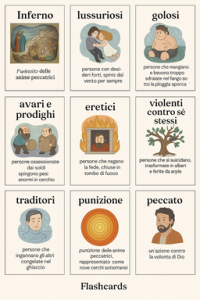
1. I golosi A. Spinti dal vento per semper
2. I traditori B. Sdraiati nel fango sotto la pioggia sporca
3. I lussuriosi C. Chiusi in tombe di fuoco
4. Gli avari D. Congelati nel ghiaccio
5. Gli eretici E. Spingono pesi enormi in cerchio
6. I violenti contro sé stessi F. Trasformati in alberi e feriti da arpie
© 2025 Iliana Dechkova