From "Once upon a time - manners and worldview of the Bulgarians"
Lazarovden is a multi-layered holiday. It is strongly associated with both Christianity and folk belief and various rituals are performed on this day.
The biblical myth of the resurrection of Lazarus
On Vrabnitsa, when Christ solemnly entered Jerusalem and learned that his friend Lazarus was seriously ill, he immediately went to his home. But there he found only the grieving relatives. Lazarus was already buried. His sisters Martha and Mary reproached the son of God: "Lord, if you had been here, my brother would not have died." - Martha said and continued: - "But even now I know that if you ask God, he will give it to you." When went to the grave of his friend, He said three times: "Lazarus, come out." And Lazarus immediately came out, wrapped in linen on his hands and feet and with a towel on his face. "He's alive," everyone shouted. After that, Jesus again went to Jerusalem, and the resurrected Lazarus lived another thirty years in fasting and abstinence and was proclaimed the first bishop of the city of Kition, Cyprus.
Folklore collection "Once upon a time - manners and worldview of the Bulgarians"
The image of Lazar in Bulgarian folk mythology
Lazar commands the forests and the scum. He cuts down the trees with his ax and thus makes fields for ploughing, i.e. it reclaims spaces for man from the chaotic world and thus creates order. Lazarus personifies the border of the earthly and the other world. Therefore, Lazarovden in the folk calendar is a holiday of forests, fields and pastures. It is especially important for young girls. Once the girl has been betrothed, she can now be married, i.e. they have the right in public to dress and behave in such a way as to please the bachelors. They have the right to have a marriage and to marry. In Western traditions, at the age of 15-16, a girl was introduced to society. This is actually the first appearance of a public ball. In ancient times, no matter how exactly, the peoples of the world had strict moral norms of behavior across generations.
The holiday is called Lazarus, Lazarnitsa, Lazarus Saturday. There are three main rites - lazaring, choosing a kumitza and buenek. All of them are connected with the girl's transition from childhood to maidenhood, with love and domestication of the girl.
 On the day after Lazarus Day, according to the old traditions, a week before the Resurrection, God releases the dead. They came out of their graves waiting for their relatives to bring them something. Therefore, on this day, a stew or memorial for the deceased is also made. On Friday opposite Saturday, wheat is boiled and ritual breads are prepared - rangelo bread, made from fat-free dough. One of the ritual breads is larger, and on top a cross is made from the dough and smaller prosphora, according to the number of deceased. The graves are burned or poured with wine the evening before the holiday or the morning of Lazarov's Day, and as on every commemoration, wheat, rangelo bread and prosphorki are distributed.
Lazarus
A custom known since ancient times. In ancient times, the maidens of one tribe or village were kidnapped by the boys of another. This happened in early spring in a forest by a river. In its historical development, the custom has preserved its primary features to this day.
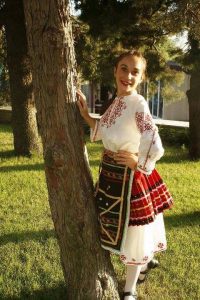
Lazarus is an economic custom related to fertility and the continuation of the family. It has nothing to do with the biblical Lazarus and his resurrection. Girls aged 13-14 are called podevki. They start their preparations for the feast from the middle of the Easter fasts or from St. 40 martyrs. They begin learning Lazarus songs and dances under the guidance of more experienced and older women. They also choose a guide. In Thrace the guide is called kuma, in Eastern Bulgaria - boenets, boenitsa, vodnitsa, godmother, and in Pirinsko she is called a breeder. During the Easter Lent, the bachelorette party is not played, but the wild, unconcluded horo painting, known mostly in the Eastern Bulgarian regions, is an exception. In different regions of the country, the rituals are different in details, but in their essence they carry the same symbol.  The Lazar women mainly sing ritual songs. The songs are different according to the gender, age, marital status and social status of the one for whom the song is intended. It's a must for every girl to laze around. A girl who was not a lazarka, her dragon will love her and kidnap her.
In addition to going to the houses to sing, the lazarkas necessarily go around singing in the fields, forests and vineyards for fertility. The songs are not random. With each chorus, the maidens call out what the year will be. The landlady of the house where they sing necessarily presents them with honey, flour, grain, eggs. The housewife takes out the flour in a sieve. Then he rolls the sieve and by the way it falls, they guess about the fertility. The best sign is if the bottom remains above.
A girl can only be a lazar once. Do not stay in a house where there is someone who is sick or has recently died. From Lazarov Day to Tomina Sunday, there is no commemoration of the deceased.
© 2023 Iliana Dechkova