
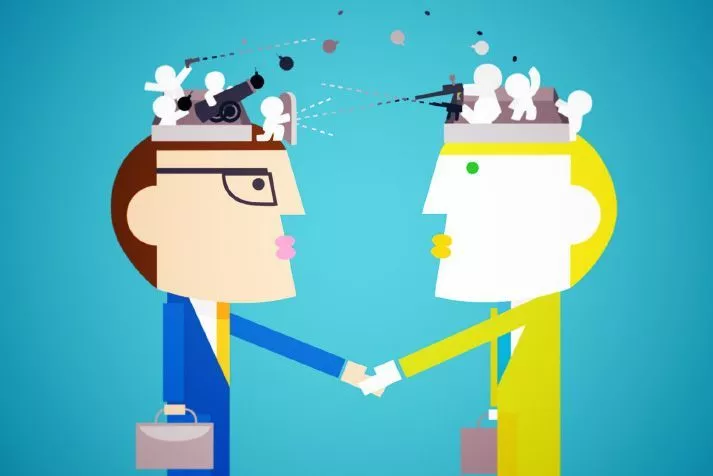
How does lightning-fast cognition occur? And how exactly do we make an instant decision?
Many people do it unconsciously and their only explanation is that they get an unpleasant feeling in their stomach or their ears ring strangely. But this is not a scientific explanation. After a number of experiments, it turns out that in fact our free will is an illusion and most of the time our mind moves on autopilot. Our actions and decisions are often the result of external influence and manipulation. Knowing a person or situation quickly has its dark side. Driven by prejudices and clichéd stereotypes, we often do not bother to look beyond them and our decisions are based on incomplete information.
Through the first impression we can often judge much better and more accurately. However, we must accept and understand those circumstances in which this instant knowledge misleads us. The secret is not to allow universally imposed stereotypes to drown out any other information we would receive in the given situation. For example, if a man applies for a key position and is short and non-white, it certainly does not mean that he is not intelligent or that he does not have the necessary qualities. Another great example of information suppression is a woman behind the wheel. We all know what the general opinion is - that women are not good drivers. And if we get into a taxi with a female driver, most of us will instantly succumb to this cliché and perhaps get out of the taxi because we won't allow our subconscious to pick up on the other information and properly judge the woman in question.
A little knowledge goes a long way
When our subconscious mind analyzes narrow slices of information, it actually does so completely automatically and quickly. This is done on the basis of body movements and position, look, tone of voice. When analyzing a situation or a person, we must be able to perceive the invisible signs. This type of analysis can be compared to the analysis of signals from a radio transmitter. If we can pick up the pattern, the style of the transmitter, then we can pick up his signals easily and quickly from anywhere. It's the same with people. Different people actually match the same patterns of behavior. Once we determine the pattern of behavior, our brain can then easily analyze and "pick up" that pattern in different people and situations.
When we make spontaneous decisions or our intuition is triggered, our brain sifts through the information, discards the unimportant information and focuses on the important aspects. And very often, narrow slice analysis very often provides more meaningful answers than long and in-depth solutions.
© 2024 Iliana Dechkova