

Кое прави нашата комуникация толкова специална, когато сравняваме човешкият език и езикът на животните? Изследвайки този въпрос, Джон Лайънз (1978) стига до извода, че дефинирането на езика е предизвикателство, изискващо дълбоко разбиране. Докато животните използват вродени сигнали за оцеляване, човекът е превърнал словото в изкуство и инструмент за споделяне на сложни идеи.
It will be human language.
In 1978, John Lyons (Lyons 1978), discussing attempts to define the concept of language, came to the conclusion that defining language is just as difficult and even impossible as defining life. And he doesn't give a definition. Chomsky, for his part, rejecting traditional definitions of language as incomplete, gives a completely new and unexpectedly abstract definition, saying that language can be defined as a discrete infinity. The content behind this definition emphasizes two very essential features of human language that make it different from both animal language and machine language, even from those high-tech computer inventions that can learn themselves .
- By discreteness, Chomsky means that language is divisible into parts and can be seen as a set consisting of certain elements that can be combined.
- Infinity is the creativity of human language, which means that a person can understand and produce sentences that he has never heard, seen, or created in his life.
The language на животните
All animals have their own speech, but they do not know the language that names. These are signs of a sensory nature (visual, olfactory, tactile, auditory) that do not derive from a previously established and consciously used code. And although none of their various utterances seem to express thought, their signals have informational value. They resemble responses (like the light or the sound signal), but the animal that gives them, as well as the one that receives them, does not convey any symbolic meaning to this communication.
- Features of both languages
The two types of language share some similar characteristics:
- they are natural phenomena that are genetically inherited, e.g. – people can talk, but cats can meow, or dogs can bark;
- both in the human species and in individual species of animals, language serves for communication, i.e. to convey certain meanings.
From here on, however, a number of essential differences follow, which refer the language of animals and human language to two mutually incomparable systems.
The language of animals - According to Steven Pinger, it is based on three models:
- Ultimate repertoire of calls; one to defend territory, one to warn of danger, etc.
- Continuous analog signal; the strength of a state is registered - the livelier the dance of the bee, the richer the source of food found by it
- A series of random variations; repetitive bird song
Human language
- CHE is creative. In animals we have a certain set of sounds or meaningful body movements. In humans, language resembles the infinity of natural numbers (Bojilova, "Philosophical concepts...", 2009);
- THAT is not an imitation product. Despite many philosophical notions that children imitate the language of adults and thus acquire it, in fact they create their own language, at the lexical and grammatical level, and construct a language different from that of adults. Despite grammatical errors in early childhood language, acquiring the vocabulary and grammar of a given language is a natural and environment-independent process. A common argument to the contrary is that parrots talk. This is true because these birds possess a physiological feature of reproducing discrete sounds. But how many sentences can a talking parrot say? 10-100-1000…however gifted this bird is, that's a finite number of linguistic manifestations (Bojilova, "Philosophical concepts...", 2009);
- Each CHE has lexical and grammatical means, with which he expresses past, present and future; even languages like Chinese and some Eskimo languages that do not have a verb form. In animals, expression is here and now (Shopov, "They speak other languages", 2014);
- THAT it has form and meaning. It has a structure with combinations of sounds, letters, words, gestures that express meaning. In animals, signs are like a code system - permanent, unchanging (Shopov, "They speak other languages", 2014);
- THAT can name abstract concepts such as freedom, life, love, even non-existent artifacts - fairy tales in all languages abound with fantastical creatures such as elves, vampires, hali, etc. (Bojilova, "Philosophical concepts...", 2009);
- Under normal, natural conditions, language emerges on average at the age of about 1 year and 2-3 months in all normally-born and genetically healthy children who are raised in a normal family environment. Every child of this age, regardless of the cultural or social conditions in which he lives, speaks a human language. It doesn't matter if he lives in a thatched hut or a palace. Both children at this age begin to produce discrete sounds that, arranged in a certain way, carry (for them) a certain meaning. This undeniable fact shows that language is part of the human genome. Only the individual language directly depends on the presence of a specific language environment. For this reason, human children speak the language of the environment - Bulgarian, English, Hebrew, etc. But every child speaks the language of the current environment, not his "native" language. Animal language does not depend on the environment in any way. Kittens "adopted" by dogs do not learn to bark, nor do puppies learn to meow (Bojilova, "Philosophical concepts...", 2009);
- The man speaks the language of the environment in which it grows and lives, but at a given moment can absorb and other human language. Animals do not have this ability. A dog cannot learn to sing like a nightingale or meow like a cat (Bojilova, "Philosophical concepts...", 2009);
- THAT is changing fast as a phenomenon of culturea. Animal language changes slowly, at the rate of genetic evolution. (Shopov, “They Speak in Other Languages”, 2014)
Despite the many differences, we cannot categorically claim that there is no communication between humans and animals. But in general, communication boils down to the fact that animals demonstrate certain behavior as a result of certain linguistic stimuli from the human side (at the command "sit" the dog really sits).
Why do people talk? A person is born with the potential to understand and produce language. Chomsky proposed the idea that the human brain possesses a certain genetic characteristic for the inheritance of language.
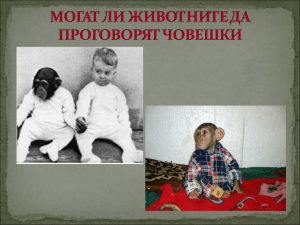 Can animals speak humanly?
From what has been said so far, we see that full communication between humans and animals is not possible. A number of experiments have been done on this matter.
The Gua and Vicky Experiment
In the USA, the first experiment of breeding a primate in a human environment was done by the anthropologists Kellogg. Similar attempts were made in Russia at the beginning of the 20th century.
The Kellogg family's experiment was done in the 1930s. They cared for their baby and the baby chimpanzee equally for about a year. When the human infant began to imitate the sounds made by the chimpanzee, they stopped the experiment. According to their report:
- The baby and the monkey learn the new behavior equally.
- There is no way a monkey can learn more than a dozen words because it lacks certain areas of the brain; moreover, the speech apparatus of apes is not adapted to the articulation of human sounds.
- Two-year-old chimpanzees and human children develop receptive listening and comprehension skills, but the monkey cannot achieve production (speech).
Project Washoe
The Gardner family psychologists trained the Washoe chimpanzee in the 1960s in American Sign Language, which has the qualities of a full-fledged human language. After 5 years, the monkey has a vocabulary of 350 words. Researchers consider a sign learned if it has been used for 14 consecutive days. This experiment shows that the chimpanzee can communicate with humans only in sign language, but it relates the signs to corresponding linguistic categories. For example, the sign for "flower" refers to all flowers, not any specific one.
Project Nimes
Psychologist Herbert Terrence conducted a Washoe-like experiment with Nim the chimpanzee in order to disprove Chomsky's hypothesis that language is innate in humans. Nim was trained in a controlled environment and in two years learned 125 sign-words and was able to combine two words meaningfully. Can answer questions. The conclusion of this experiment is that there is no syntax in communication, therefore it is not human communication.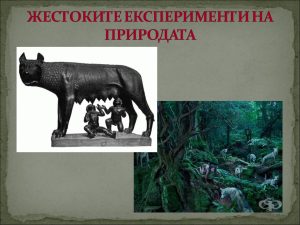
Nature's cruel experiments
Such cases have been described by many researchers. It concerns children who, for various reasons, grew up in an inhumane environment. Such children have not gone wild, they are wild because they have not been socialized. In ancient mythologies, there are many legends about children raised by animals: Romulus and Remus, Khan Avitohol, etc.
- In 1724, a German peasant encountered a naked, black-haired creature, apparently about 12 years old. It made no sounds. They named the boy Peter, and two years after finding him, they sent him to King George I for scientific research. Peter never learned to speak (Shopov, "They speak other languages", 2014);
- In 1799, in southern France, they found a child in the woods. They call him Victor. It was believed that the child lived in isolation from humans for 7 years. Victor lacked the two things that distinguished man from animal - empathy and language. During his 40-year life, Victor did not acquire human behavior (Shopov, "They speak other languages", 2014);
- In 1970, a 13-year-old girl, nicknamed Ginny, was found living forcibly in solitary confinement, in a barred, windowless room with no means of communication with her family. At first the child is almost mute with a passive vocabulary of 20 words. And she, like Victor, does not learn to speak. Ginny's case was described by Russ Reimer in 1994.
Children like Victor and Ginny reach a low point of language acquisition, after which their speech does not develop. The reason is that without a human environment this cannot happen.
Here are a few more cases collected by photographer Julia Batten. After much research into various stories of children raised by wild animals, the German woman, who has lived in London for years, presents her view of life in the jungle in a gallery of photos:
- Marina was kidnapped in 1954, when she was only 5 years old. from a remote village in South America. The kidnappers throw her into the forest. She lived with a family of small monkeys for 5 years before being discovered by a group of hunters. She eats fruits, roots and bananas left for her by monkeys, sleeps in tree holes and walks on all fours. One day I even got food poisoning. One of the bigger monkeys carries her to a pool of water and makes her drink from the water until she vomits. She eventually recovers. Marina becomes friends with the monkeys. He learns to climb trees and learns what is safe to eat. She forgets to speak. She was sold to a brothel by kidnappers, but managed to escape. She is later taken as a slave by a family, but is rescued by a neighbor who sends her to Bogota to her daughter and son-in-law. They adopted Marina and accepted her as one of their five children. In 1977, the whole family moved to Great Britain, where they still live today. She marries and has children. Marina and her young daughter Vanessa James are writing a book about her experiences as a savage.
- Prava is a 7-year-old boy found in a cramped two-room apartment, along with his 31-year-old mother — but he's housed in a room full of caged birds. She treats her son like a pet. He is not physically harmed, he is not left without food, but the mother never speaks to him. The only communication is between him and the birds. Instead of talking, he chirps. When he is not understood, he flaps his arms like a bird. Prava is taken to a mental care center, where doctors try to teach him to behave humanly and socialize him.
- Shamdeo, a boy about 4 years old, was found in an Indian forest in 1972. He plays with little wolves. His skin is very dark, he has sharp teeth, long claws, matted hair and calluses on his hands, elbows and knees. When he is found, he is hunting chickens and eating dirt. He barks like a dog. He is eventually weaned from eating raw meat, but he never speaks. He only learns a few signs. In 1978 he was sent to Mother Teresa's home for care, and his name was changed to Pascal. He died in February 1985.
- Oksana was found in a dog kennel in 1991. She was 8 years old at the time and had lived with the dogs for 6 years. Her parents were alcoholics and one night they left her alone outside. Seeking warmth, the then three-year-old Oksana crawled to the doghouse and huddled among the dogs—an act that likely saved her life. When she was discovered, she acted more like a dog than a child. She ran around on all fours with her tongue out. She also bared her teeth and barked. Due to her lack of contact with humans, she only knew the words “yes” and “no.” Intensive therapy helped Oksana progress, but she only reached the level of knowledge that a 5-year-old child possesses. 30 years later, she lives in a clinic in Odessa and works with the animals from the hospital, but under supervision. (Steinberg and Sciarini 2006, 100)
 Critical period hypothesis
There is a critical period in a person's life for language acquisition. This period is connected with the intellectual development of the individual and with his socialization. When this period passes, the language cannot be fully mastered.
According to the hypothesis, discussed in detail by Tom Scovel in his book “Time to Speak” (Scovel, 1988), the critical period for second language acquisition is the time of puberty, around the age of 12. Successful language acquisition is considered to be the acquisition of an “authentic accent.” After this period, this is impossible.
Brain studies show the connection between neurological and language development in humans. At the beginning of puberty, the two hemispheres acquire different functions: the left "directs" to intellectual and analytical processes, reasoning, logic, while the right "responsible" for emotions, insight and imagination. Usually the left dominates, which manifests itself with the effect of right-handedness, and with lateralization of the brain, i.e. when it "splits", language functions are controlled by the left.
From everything said so far, we can conclude that human language is a phenomenon that is specific only to the human race, but on condition that the child has grown up in a human, social environment and has not passed the puberty phase, after which, although human, he would not be able to fully acquire language.
Cited and used literature:
Shopov, Todor. They Speak Other Languages, an Introduction to Pedagogical Sociolinguistics, Sofia, University Press "St. Cl. Ohridski", 2014
Boyadzhieva, Eli. Philosophical Concepts in Contemporary Linguistic Theory and Methods of Analysis, Southwestern University, http://notabene-bg.org, issue 1, 2009
Batten, Julia. THE WILD CHILDREN: Shocking Stories of Kidnapped and Abandoned Children Who Grew Up Like Mowgli, http://kanal3.bg/news/lifestyle/lubopitno/16962-DIVITE-DECA, 2015
© 2026 Iliana Dechkova