
Christmas Eve is one of the most important days of the year for a Bulgarian. The holiday is not movable and is also called Little Christmas. In our native folklore, the rituals and rites with which the birth of the son of God is welcomed are rich. There are many symbols that accompany the holiday. In the holiday-ritual system of Christmas Eve and Christmas, the biblical ...
Excerpts from the folklore collection and description of the main symbols in Bulgarian folklore
The collection is an encyclopedia that can be read all the time and not necessarily all of it. The old traditions of every nation are valuable. To better understand the present and make our way to the future, we need to know our past well. In order for humanity to exist and live in peace and harmony, order is needed. In the old Bulgarian traditions, we find that cosmic order, that hierarchy that has helped us survive over the centuries.

IGNAZHDAY – December 20
According to the proto-Bulgarian calendar, this is the single day, which is not included in any of the months. It is considered the beginning of the new year. The day marks the winter solstice, when the day is shortest and the night is longest. In the distant past, this astronomical phenomenon occurred around December 20. In 2023, the winter solstice falls on …

Winter holidays between Nicholas Day and Ignazhden
WINTER ST. ANNA - December 9 Saint Anna, according to the Bible, is the mother of the Holy Virgin and grandmother of Jesus. On this day, the conception of St. Mary. Anna is a descendant of the famous Aaron family. She is the patroness of women in labor, pregnant women and the family. The people call the holiday Janino or Annino's conception, New Year's Day, Annino's introduction, ...
Прочети цялата публикация →„Зимни празници между Никулден и Игнажден“

CHRISTMAS – December 6
The holiday is Christian and folk. It is dedicated to Saint Nicholas the Miracle Worker of Mirlikia or Saint Nicholas, patron of the seas and of sailors and fishermen. Nicholas was born in 280 in Lycia, a province in Asia Minor into a rich and famous family. He is known as an opponent of paganism and Arianism. Nikolay is the Russian form of the name Nikola. …
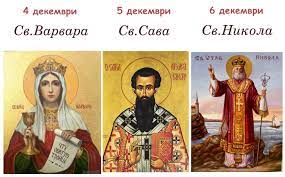
SAINT SAVA and BARBARA – December 4, 5
The day of St. Barbara is celebrated on December 4. The people consider the saint to be the patron saint of smallpox – a disease that mostly affected children, but also many adults. In order not to get sick, they did not mention this name on that day, and to appease her, they called her Baba Sharka. In Thrace there is a custom of slaughtering a hen...
Прочети цялата публикация →„СВ.СВ.САВА и ВАРВАРА – 4, 5 декември“

Folk instruments - KAVAL
The kaval is a musical instrument from the group of woodwind instruments. He is an inseparable companion of the Bulgarian shepherds. It is found in almost all folklore areas, being the most characteristic in Thrace, Ludogorie and Dobruja. It is used as a solo instrument and in folk orchestras and ensembles. It has a soft and pleasant tone. Importance of Types of Garment Parts – …

Symbolism in folk art - THE HYSTERS and the DRAGON
From "Once upon a time - manners and worldview of the Bulgarians" Orisnits The people call them orisnits or adverbs. The three women who, on the third day after the child's birth, go to his home at night and determine his fate. Orisnikas are of different ages. They stand above his head and the youngest begins. Then the middle and finally the oldest. The power…
Прочети цялата публикация →„Символиката в народното творчество – ОРИСНИЦИТЕ и ЗМЕЯТ“

Main parts of the house according to folk beliefs
From "Once upon a time - manners and worldview of the Bulgarians" The hearth After the house is ready, half of the rites and religious customs are performed in honor and around the hearth. The hearth in many rites and customs replaces the house and the concept of house. It is not by chance that songs often sing "father's hearth" instead of "father's house". The hearth is…
Прочети цялата публикация →„Основни части на къщата според народните вярвания“

The role of the house among the old Bulgarians
From "Once upon a time - manners and worldview of the Bulgarians" Building a home was a sacred act for our ancestors. The first sod for a man was a sacred rite, something with which he enlightened himself and became the master and ruler of the home. The old Bulgarians knew which place was suitable and which was not, for building...
Прочети цялата публикация →„Ролята на къщата у старите българи“

Rituals in folk art
From "Once upon a time - manners and worldview of the Bulgarians" Family customs and rites mark the most important moments of human life. "One is born once, married once and dies once," says the popular saying. Each of the rites and rituals associated with birth, marriage and death are similar. The first element is preparation, the second is initiation and passage...
Прочети цялата публикация →„Обредите в народното творчество“