From "Once upon a time - manners and worldview of the Bulgarians"
The pagans
 In folk customs, there are beliefs about the existence of goblins, vampires, goblins, werewolves, mermaids and elves - all creatures from the other world. Some of them were thought to be very dangerous, especially during the so-called Pagan or Dirty Days - from Nativity to Epiphany, a dangerous time, a time of evil, especially from sunset to the first rooster crowing. Then they went out and roamed the earth. Woe to any mortal if he encountered them. They could harm people, make them sick or even kill them.
 According to other beliefs, mainly in Northern Bulgaria, there were mythical female beings - mermaids and samoivas - who came to the world of people on Spasovden, 40 days after Easter. Divas and mermaids were dual beings. They brought fertility to the fields, they could also heal, but they took cruel revenge on those who dared to anger them. Therefore, during the Rusal week, which begins with the feast of the Holy Spirit, 51 days after Easter, people observed a number of prohibitions: not to work, not to sleep during the day and, above all, not to walk in the forests and fields alone. If a person stepped on a Samodiv or Rusal gathering or a spring, he was punished with a terrible Rusal disease. The patient fainted, staggered and often died.
Guardians - healers
One of the most prominent guardians and defenders of the people from these evil beings was a group of men who performed mysterious rituals to ward off evil forces. They were called Rusalia or Kalushari. These mysterious men went around the villages in groups and played for health and fertility and to drive out evil spirits, like lazarkas or kukers. The special thing about them was that, in addition, they were also healers. The Rusalians had the right to heal only one week a year. This week, according to legends, began with the Dirty Days, with the feast of St. spirit or on Midsummer... people tell different stories.
The rules of the squad
During the Rusal week, the group toured the villages. At the crossroads and in the middle of the village they danced, then went around the houses and crossed everyone with their sticks on the forehead "for health". In this way, the shops also crossed in three places - on the door, on the hearth and in a third place, which is at right angles to them. In a house with lehusa / a young woman in labor who has not yet given birth for 40 days/ did not enter. The Rusalians were very careful not to meet another party on their way. Then the two teams fought and nobody gave way, to the point of blood. They often fell dead, who were then buried without a priest singing them. If the squad was much weaker, it submitted without a fight to the enemy and passed under two sticks of the stronger squad joined at the ends, as a sign of submission. Before sunset, the group always returned to a house, so as not to find the night in the open air.
Rusalii were a group of men, an odd number, usually seven. The leader of the group was called a watafin, and watafship was passed down from father to son, rarely by merit. It was he who possessed the secret knowledge and introduced the company to it at midnight, before the first day of the Rusal week. The Vatafin beat his boys very carefully. They had to be healthy physically and mentally, have a good soul, be honest and be able to keep a secret. All this was necessary for them to have the strength to perform the complex rituals in such a way as to both help the sick and not harm themselves. Not everyone could become a mermaid. Usually this was passed down by inheritance, so was the watafship. The future mermaid was trained for years. when he was elected, he had to fast for a week and keep silent - all tests of an enduring spirit. After that, the vatafin gave him various tests. During the initiation of the new member of the group, the watafin administered him special water with herbs and assigned him a preceptor to train him in the sacraments. Finally he took an oath and only then was he allowed to practice the trade. The new mermaid swore in front of the flag and staff, kissed the hand of her new comrades and took her staff for the first time.
During the Mermaid Week, the group was constantly together and observed a number of prohibitions:
- They don't talk to each other except in the evening, and then little and quietly.
- They don't baptize when they eat, they don't bless when they drink, they don't greet when they meet someone.
- Walking in pairs one after the other, they do not allow anyone to cross the chain, to pass between them, and each follows in the footsteps of his predecessor. Only the sick can split their choirs when they play and sit in the middle to heal.
- They never tread water: small wadis are skipped, rivers are crossed by a car.
- If one of the company falls behind for any reason, his comrade does not leave him, but stands by him and waves his sword over his head to protect him from evil spirits
- When they stop for the night, they don't split up, they all stay in one house, wider so that other guests can also gather.
- If they arrive in a village where a Rusalian is from, he dare not meet his relatives.
- The troupe sends out messengers to warn the villagers of their arrival and is met with honors – just in case they meet up with another troupe of Rusalians and fight.
- If they meet on their way a well, a dry tree, an old cemetery, a crossroad, they walk around them three times and cross their swords, resting the point on the ground and shouting "ehee".
During this period, they were in a borderline state - between the human world and the afterlife. And only then could they see the mythical creatures from the other world and defeat them.
Dress and manners
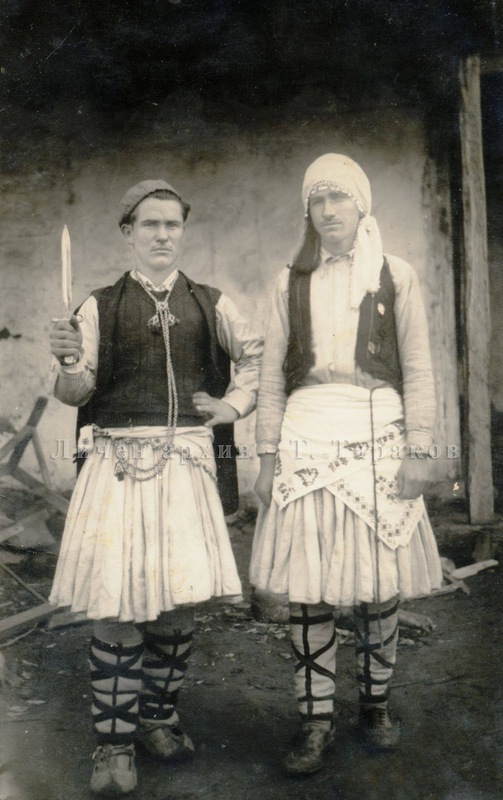
The Rusalians' clothing was their usual, often white, but they still distinguished themselves this week with some items they wore. All had patterned, wooden clubs, which during the rest of the year were protected from the wax. These sticks had wild herbs hidden in them, and their tips were made of metal so that they would stand straight, driven into the ground, like a human strength. When the staff rotted or withered, it was buried with its last owner. It was inherited from father to son. They tucked red towels into their belts. On their legs and staffs, the rusalians had metal bells that timed each movement. The company also had a banner of white linen cloth, trimmed at the end with magical herbs. The flag was lit with a special ritual and carried only by the watafin. No one was allowed to touch him, they didn't even dare to stand under him, because his power was enormous. Besides these things, the guide carried a pot of water, herbs, and a jar of garlic and vinegar. In magical rusal rituals, music played an important role. In general, music has always been part of the sacred sacraments of Bulgarians. Through her, the Rusalians made contact with the beyond. That's why there was always a drummer and a kaval or bagpipe player in the group.
The Rusalians treated all kinds of diseases, but their mastery was seen when they succeeded in curing the diseases of the spirit and soul. Today we call them depression, schizophrenia, epilepsy, etc.
The ritual
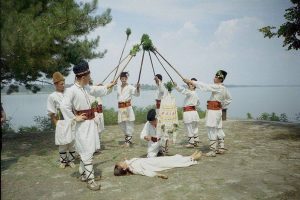 The healing ritual was done like this: the sick person lay down on the ground, on a rug, and next to him they placed the pot with the herbs. The Rusalians lined up in a circle and began to dance their magic dance in a circle around the sick person. Only the Vatafin remained outside the circle with the flag and the flag and led the others. The dance started slowly and got faster and faster. Finally, the men played wildly. Falling into a trance - a state close to trance or hypnosis. They lifted the patient with the rug, shook him, then jumped over him three times. During this time, the watafin rubbed him with the vinegar from the pot, gave him to drink from it, and sprinkled him with water from the pot. Finally, the musicians played the special melody. They called her the Florichika and she resembled a handkerchief. The dance required extreme endurance, therefore the future mermaids were also chosen for their physical qualities. They danced spinning movements, and the dance could go on for hours. At the moment when the men stuck their staffs into the ground to draw from the strength, the watafin entered the circle and chose the mermaid who at that moment was the strongest. He looked into his eyes to see if his soul would endure. He gave him to drink the herbs and in a mysterious way, with spells, lured the disease from the sick person in him. At the same moment, the patient should have jumped up and run away - it was believed that he had recovered. And the headman and the group continued with the mysterious dance until he took the shine out of his comrade. When the mermaid sobered up, the ritual ended.
The man was a ruslai until he had the strength to perform the rituals and endure the dance. He would then retire and pass his staff on to his son if it was decided that he could succeed him. If not, she was leaving with him.
In northern and southern Bulgaria there is a slight divergence in the peculiarities of the ritual. In the North, the number of ruslaii is odd, and in the South, the boys went in pairs and the group was an even number. This is associated with the winter and summer solstice. The first one is usually on an even date / December 22/, and the summer one on an odd one / June 21/. That is why the northern Rusalians performed the custom during the period of Dirty Days, and the southern ones - around Spasovden or Epiphany.
The symbols
The symbols of the Rusal company are not accidental. The wooden staff is the image of the cosmic tree that helped to remove the disease. This belief is similar to the beliefs of the Bogomils. They believed that anguish was a contagious disease and had to be removed by being tricked, and health was imparted by tormented water. The staff was also a kind of sword with which healers defeated the underworld. This pytyal is connected with the achievement of victory over the nether world with the help of the sword. The herbs it is not by chance that they chose those with antiseptic, purifying and anti-inflammatory effects. The red cloth is a symbol of blood, a symbol of life. The water was particularly special. It had to be clean, usually poured by the watafin himself, from a holy spring and "machlana", i.e. not to carry any information other than itself. The rites before the choir were performed in complete silence so that the healers could concentrate as much as possible. Then, when the kaval or bagpipe was played and the drum struck, the water was positively charged.
The essential thing about the rusal rite is the return of the integrity of the community and alignment with A-za. This is achieved by making a sacrifice or gift in exchange for receiving another gift - health.
© 2023 Iliana Dechkova