From "Once upon a time - manners and worldview of the Bulgarians"
GEORGE'S DAY – May 6
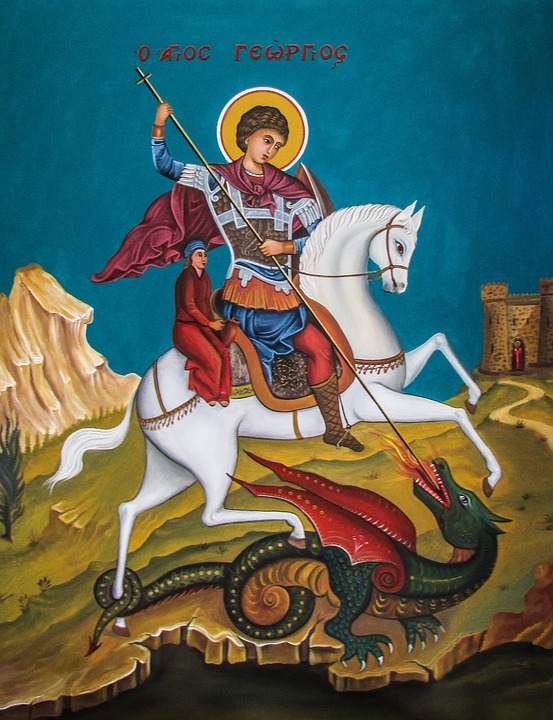
The day dedicated to St. George the Victorious is also both a Christian and a folk holiday and one of the biggest spring holidays. After this day, the Bulgarian economic year and the working season begin. The rich landowners hire workers, the emigrants set off on their journeys, the shepherds from the Rhodope Mountains drive their flocks to the White Sea plains. And as on a holiday, the preparations begin the day before. The maidens weave wreaths of spring flowers and decorate the St. George lamb with them, the first male born to be slaughtered for sacrifice. The ritual breads are also mandatory here, with the largest one being called St. George. Bran, grass and salt are placed on the table in advance and given to the lamb so that it will be well-fed and fertile for the year. Then its blood is collected and poured into the beds in the garden - again for fertility, health and life, since blood is a symbol and engine of life. The table is incensed, songs are sung and everyone is happy. Young people tie swings to fruit trees. Those maidens and bachelors who have not swung on St. George's swing will not get married during the year. The night before, unmarried girls leave bracelets and wrists in a white cauldron with still water to stand under the open sky and on the day of the holiday they tell fortunes and call out which maiden will marry whom. And young brides go out to the square in their bridal attire. Their best men ritually remove their outer clothing and shoes, give them ordinary ones and tie them up. The headscarf is a sign that the woman is now married and will wear her headscarf to the grave. The first two rituals have an initial meaning - continuation of the lineage, and the third aims to include the newlyweds in the group of mature women.
The saint is the patron saint of flocks, shepherds and brave warriors, which is why today the holiday of the Bulgarian army is also celebrated on this day. In legends and iconography, he is always represented on horseback, with a spear in his hand, defeating the dragon and saving the maiden from captivity. All this symbolizes the victory of warm and light over dark and cold.
Name days are celebrated by: Georgi, Gergo, Gergana, Gero, Gyurga, Geto, Getso, Gotse, Guga.
GERMAN – May 12
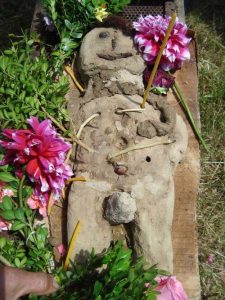 This holiday is known mainly in Northern Bulgaria. A completely folk holiday, without Christian motifs. The day is associated with the pagan lords of the heavenly storms – hail, rain, fire elements. It is called German, Gecho, Jerman, Kaloyan, Kabaivan, Skaloyan, Dragancho, and the rituals aim to pray for rain so that the harvest does not dry out. It is also called German Gradushkar, because it both brings rain and protects from hail. German is the first, most important hail, and his twin hail brothers are Bartholomew (June 11), Lise (June 14) and Vidovden (June 15).
The custom was often performed on Butterfly Day, but always after it. It is mainly attended by girls who make a doll out of mud. The doll resembles a person and is 20 cm to 50 cm in size. It depicts a naked man, a dead man, with clearly defined sexual characteristics. The doll is placed on a roof tile or in a specially made box for the purpose, decorated with flowers and buried like a person. It is dug up on the third, ninth or fortieth day and thrown into water.
PENTECOST – 50 days after Easter
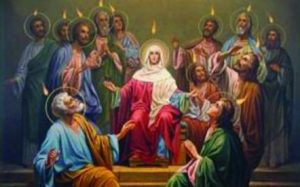 50 days after the resurrection of Christ, the Church was founded on Earth, and Christ sent the Holy Spirit. In the Jewish calendar, this is 50 days after Easter. At that time, Jerusalem was full of pilgrims who had come to honor God's law on Mount Sinai. The Mother of God, together with the twelve apostles, prayed in the house where they had their last supper with Jesus. There was a noise, as if a strong wind had blown, and over the head of each appeared flames like tongues of fire. The Holy Spirit filled the apostles, and they began to glorify God in all languages, although they had not known them before. Thus the foundations of the Church were laid, and the apostles began to preach the teachings of Christ to all nations.
© 2023 Iliana Dechkova