
The holiday is Christian and folk. It is dedicated to Saint Nicholas the Wonderworker of Myra or Saint Nicholas, patron saint of the seas and of sailors and fishermen.
Nicholas was born in 280 in Lycia, a province in Asia Minor, into a wealthy and famous family. He was known as an opponent of paganism and Arianism. Nicholas is the Russian form of the name Nicholas. The name Nicholas is of Greek origin and comes from the Greek words conquer (nikáo) and people (laós). At that time, the emperor was Constantine the Great, who took part on his deathbed in the First Ecumenical Council of Nicaea. Nicholas is famous for his sea miracles, saving hundreds of sailors from drowning in storms, protecting them from water monsters. The people believe that he is the brother of St. Barbara and St. Sava.
He died in 325 and, unlike most of his fellow saints, the end of his life was not marked by persecution, torment and torture for the faith. He passed away at an advanced age in honor and recognition. He was buried in the cathedral of the city of Myra. In addition to fishermen and sailors, the saint is also the patron saint of merchants, bankers, thieves, brewers, coopers, pharmacists and prisoners.
Many legends about the miracles of the saint have reached us:
The salvation of the three virgins
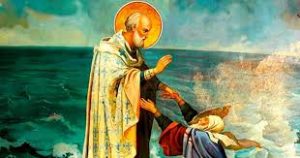 Once upon a time, women could not marry without a dowry. If they did not have one, they had no choice but to become prostitutes. A merchant had three daughters. Every time he decided to sell one of them, a miracle would happen and fate would change. But no one knew that the saint secretly threw a bag of gold coins out the window and left without waiting for thanks. Thus, the girls managed to get married. After the third time, however, the merchant ran after the benefactor to find out who he was. Just when he caught up with him, he realized that this was a messenger of God. Since then, St. Nicholas has been revered as the protector of property and money.
According to other versions of this legend, St. Nicholas threw the money bags not out the window, but up the chimney, and they fell into the stockings that were hung over the fireplace to dry. This is where the tradition in North America and Western Europe comes from, where children leave their stockings over the fireplace before Christmas, in the hope that they will be filled with gifts. At some point, St. Nicholas was identified with the modern Santa Claus.
The salvation of three children
Another legend tells how an evil butcher killed his three children. He chopped them up and salted them in a meat vat. St. Nicholas saw this monstrous deed and prayed fervently to God, and a miracle happened – the children came to life.
Rescue from a storm
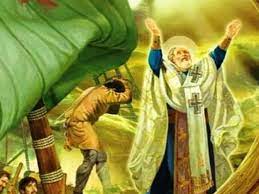 One day a terrible storm broke out at sea. The waves tossed the ship like a walnut shell. Just then the saint went to worship at the Holy Sepulcher. One of the sailors climbed to the top of the mast, but fell from there, swayed by the strong wind. His friends thought he had died, but the saint performed a miracle and revived him. Then he calmed the sea with prayers.
Another version of the legend is that the ship broke through and the saint plugged the hole with a live carp, thus saving the sailors.
You can purchase the entire collection of folk customs, holidays and the importance of clothing here:
Folklore collection "Once upon a time - manners and worldview of the Bulgarians"
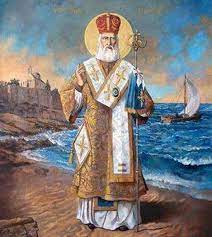 According to Bulgarian folk beliefs, when he is angry, Nikola or Nikola causes sea storms and hurricanes and sinks ships. That is why no one goes out to sea on St. Nicholas Day – neither ships nor boats. Sailors, fishermen and their families organize celebrations to appease the saint. The obligatory dish is fish, most often stuffed carp, since according to belief it is the carp that is the servant of the saint. The carp is stuffed with walnuts, bulgur, rice, onions and raisins. Somewhere they call the finished dish “ribnik”. The housewife must keep a bone from the carp’s head in the shape of a cross, because it is healing. If there is a newborn in the house, the mother sews this bone onto the baby’s cap to protect it from curses and “evil” eyes.
You can read more about the holidays here.
St. Nicholas Day is a family and family holiday. On the day of the holiday, before noon, several young men and bachelors go from house to house and invite their relatives to an evening service. But only men go to this service, and not all of them, but only the oldest in the family. When they arrive at the owner's house, they say: "May Saint Nicholas help us" or "Saint Nicholas with a white beard has come." The table is set alight, usually by the oldest. He raises the bread high above everyone's heads and says: "As many grains in the basket, so many heaps in the field! May the house be full of children, and the purse full of money!" The men eat and drink, and then go to the next relative's house. In this way they go around the entire family until morning.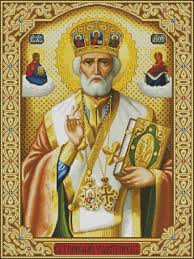
Women's rituals also have their place on this day, but they are mainly aimed at marriage. If a girl wants to get married soon, she brings flowers and gifts to the church and places them in front of the icon of St. Nicholas and fervently prays to the saint to help her. In the evening, while the oldest men - servants - go around the family and say blessings, the young people make a riotous crowd. The girls play a "sglyadno" horo, and the young men and their parents look at them and make a choice for a future daughter-in-law or wife.
© 2023 Iliana Dechkova