The birth of the holiday
May 24 is the day when every Bulgarian can be proud to be a descendant of a nation occupying a strategic place in the history of Europe. It is a symbol of dignity, tradition and spirituality. May 24, perhaps the brightest, most hidden Bulgarian holiday - the day of letters.
Our first known secular celebration of the Thessaloniki brothers in our country is more than 200 years ago and is the longest celebrated holiday in our country. In a collection of Armenian travelogues, a description was found by a priest who testified that on May 22, 1803. they took him to Shumen "to a celebration of the writing of the Bulgarians" and he saw "how they sang sad songs and then danced".
When the struggle for church independence began in the middle of the 19th century, the holiday was celebrated in Bulgaria and Russia, and since 1863 May 11 was established as a church holiday of the holy co-apostles Cyril and Methodius. In Sofia, the holiday was organized by teacher Sava Filaretov.
In 1892 Stoyan Mihailovski, a teacher at the Men's Gymnasium, wrote a hymn for the holiday of letters "Vorvi narode vozrodeni", and in May 1901 Panayot Pipkov - a teacher from the Fifth Grade Hunting School creates the music for the text. After the Liberation, May 11 became an all-school holiday for Slavic primary teachers.
The holiday began to be celebrated on May 24 after the introduction of the Gregorian calendar in 1916, and after 1969. there are two holidays - church and secular. May 11 is the day of the holy co-apostles Cyril and Methodius, and May 24 is the day of letters.
By decision of the 9th National Assembly on March 30, 1990. May 24 is declared a national holiday.
A brief history of the Bulgarian alphabet
From the beginning of the 9th c. in the next 50 years, Bulgaria became a stable European power - in economic, political and military terms. But many peoples live in the country, the language of most is Slavic, but the faith, religion and laws they follow are different. When in 852 Prince Boris I ascends the throne, he takes these features into account. He realized that the people needed laws that were the same for everyone, but this could only happen if everyone professed the same religion. And that religion was to be Christianity. Almost all of Europe at that time was Christian, and naturally they didn't take a pagan state very seriously, even though it was a super power at the time. International treaties concluded between two Christian states had more weight than those between a heathen and a Christian country. And the prince declared Christianity the official, state religion. However, the services were performed in Greek - once because of the trilingual dogma and the second time because the Bulgarians did not have their own writing system. Boris I, as a foresight and far-sighted ruler, felt the danger of the Hellenization of the people and their subjugation. But the prince knew that he could not simply order a few learned priests to invent an alphabet. This would automatically lead to Bulgaria being politically disrespected by the other Great Powers. The new alphabet had to be created by high-ranking persons belonging to one of the two centers of Christianity - Rome or Constantinople.  And the ruler has found them. At the height of his political career, in 855 the brothers Cyril and Methodius retire to a monastery. It only remained for them to wait for the day when the two great Christian powers would not oppose this work. And that day has come.
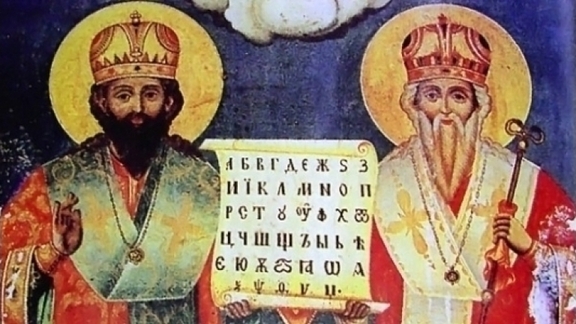
In the second half of the 9th c. the brothers Cyril and Methodius, Bulgarians by origin, probably descendants of aristocrats, but Byzantine subjects, created an alphabet in the Bulgarian language and translated the liturgical books. This happened with the blessing of the Byzantine Empire, in clear violation of the trilingual dogma (only Latin, Greek and Hebrew are God-pleasing languages). The reason for this was purely political. In 863 Cyril and his brother Methodius were sent by the Byzantine emperor Michael III at the request of the Great Moravian prince Rostislav, to baptize the Western Slavs and organize worship in Great Moravia in their native language. For this purpose, Cyril created a new alphabet - The verb. The name Glagolitic comes from the word "glagol" meaning "word" (this is also the name of the letter "G"). This is a completely original graphic system in which each letter corresponds to one sound. Moreover, in it the letters for close sounds have similar outlines. That is why the great Bulgarian scientist Petar Ilchev calls Glagolitic the most perfect graphic system from ancient times to today.
The Glagolitic script was used for state and religious documents and books, and also in the Great Moravian Academy (Great Moravian School) established by Cyril, where the students of Cyril and Methodius were taught. The goal of Byzantium was to destroy Bulgaria by imposing worship in Greek and the new alphabet was not intended for the Bulgarian people. The goal was to attract the vast Great Moravia into the sphere of influence of Byzantium.
 The new alphabet was canonically recognized and was officially believed to have been created for the needs of the Western Slavs. In order for Byzantium not to see the secret plan, Cyril and Methodius remained outside Bulgaria until their deaths. But Boris I made sure that the liturgical books translated by the brothers reached Bulgaria as well. Cyril died in 869. in Rome. After the death of Methodius, their common work in Great Moravia collapsed and their over two hundred disciples were arrested and banished by the German clergy. Three of them were released at the insistence of Boris I, as they were Bulgarian subjects. Accompanied by German soldiers, escorted to the borders of Bulgaria, Clement, Nahum and Angelarius were greeted with great joy by the Bulgarian ruler. They started the spread of the new Bulgarian alphabet - Glagolitic. They copied books, translated and educated the Bulgarian people, giving them one of the strongest weapons - the word.
Today we have computers, we even forgot typewriters. If we need something, we just copy it and that's it. But in the distant past, every book, every document was copied by hand and it was a whole art. The first letter is decorated and colored in red, blue or green or written in gold. Under the influence of the decoration in Byzantine manuscripts in the 13th-14th century, three styles were imposed in Bulgarian books:
* interludes — decorated compositions before the beginning of a block,
* initials — decorated initial letter,
* endings — concluding ornamental motifs forming the end of the text.
At the end of the 9th century, Clement created a new, simpler alphabet and named it after his teacher - Cyrillic. For several centuries, the two alphabets were used together, with Cyrillic gradually replacing Glagolitic in the Middle Ages. Individual fragments or words written in Glagolitic can be found in Cyrillic manuscripts until the 14th century. They also wrote in Glagolitic in Russia, but quite rarely. Along the Adriatic coast of Croatia, Glagolitic was preserved until the last century, mainly as a type of secret writing in some monasteries. Today it is used only in the Church Slavonic language.
Current Bulgarian began to be formed in the 15th century, but modern literary Bulgarian, quite different from Old Bulgarian, was formed in the 19th century. Until then, the original Cyrillic alphabet of St. Kliment Ohridski, which contains 44 letters for 44 sounds. In the 19th century however, the Bulgarian sound system changes radically and contains fewer sounds. This made it necessary to change the alphabet, which reduced the letters used to 32. This changed alphabet was used until 1945. After 1945 two more letters are missing: ѣ (yat, double e) and ѫ (big yus). Thus, the modern Bulgarian alphabet remains with 30 letters.
In the modern Bulgarian alphabet, many of the old letters are missing, for example: ѣ (yat, double e), ѫ (big yus, big nosovka), ѭ, ѧ (small yus, small nosovka), ѩ.
Who uses the Cyrillic alphabet today?
The name of the alphabet in Czech is hlaholice, in Slovak - hlaholika, in Polish - glagolica, in Russian - glagolitsa, in Croatian - glagoljica
In 1483 the first book in Glagolitic was printed in Venice, and the printed Glagolitic largely imitated the handwritten one.
The main works of Old Bulgarian literature are written in Cyrillic - the oldest "Slavic" written monuments. Today Cyrillic is the name given to a group of similar alphabetic systems used by various languages in Eastern Europe and Asia. Since 2007 , when Bulgaria became a member of the European Union, the Cyrillic alphabet was recognized as the third European alphabet after the Latin and Greek alphabets.
Officially created in the 9th century, today the Cyrillic alphabet is known to about 252 million people worldwide. The alphabet that has survived for more than a thousand years is used in 23 countries, in Europe and Asia. In the past, the Cyrillic alphabet was also used in Romania, until the 1970s. Today it is an official script in the countries: Bulgaria, Bashkiria, Belarus, Bosnia and Herzegovina, Buryatia, Dagestan, Ingushetia, Kabardino-Balkar Republic, Kazakhstan, Kyrgyzstan, Macedonia, Mari Republic, Mongolia, Mordovian Republic, Russia, Serbia, Tatarstan, Tuva, Montenegro, Tajikistan, Udmurt Republic, Ukraine, Chechnya, Chuvash Republic.
The spoken alphabet of the Bulgarians
In the entire pronunciation of the old Bulgarian alphabet and in the order in which it is arranged, according to Rakovski, some scientists thought that the old abbreviated Bulgarian creed - "I believe" of our once old religion was hidden in it.
We find the interpretation of this "I believe" in Rakovski's "Key", which is as follows:
1. I buki vedi (A, B, C) - I know the letters (in Sanskrit "veda" is knowledge, from the same Indo-European root from which the Old Bulgarian "vedene" comes from),
2. Verbs good to eat (G, D, E) – being able to say them / pronounce them is good, i.e. it's good to be talkative! From Old Bulgarian "verbs", which means I speak, say, utter. The expression also has another, sacral meaning: "They say, 'Good exists!'" ( "They say, 'God is with us! ").
3. Live light/earth (Ж, S-dz, Ж) – Live more with the earth/ live as one with the earth.
4. And iota izhe gervy (И,Й, I, Гх) – And in no way/not less (and iota) than her (iže) you will be fruitful (gerv) / And not less than her you will be fruitful.
( Gerv, (ger) is an old Bulgarian word expressing an abundance of vitality, power and fertility. )
5. How people think (K, L, M) – Whatever you people think (about the future)
6. Our peace (H, O, P) - ours will be peace/ we will reach joy (old Bulgarian peace from *po-kojь - Avest. "joy")
7. Strong hand words (R, C, T) – Say the words firmly:
8. Uk (learn) furt hѢr (U, F, X) - he who learns casts God's light/ the knower radiates God's light. The name of the letter Ф – ФРТЪ comes from the verb to throw (quickly), scatter. The ecclesiastical letter X was a sign, a symbol used to denote immaterial, supernatural phenomena), hence - ХѢРЬ - divine reason/power/provision; ОУКА ФРФТА ХѢРЪ - the learner/knower sheds God's light/provision.
9. Worm (Ch, Ch) - In the old Bulgarian calendar, the month of red means sickle or harvest, and a worm is a sickle, in the imperative form "Take a sickle/start reaping"), i.e. - Reap (knowledge)!
10. Oh Sha Qi! Er, er, er! (Ш, Ц, Э-Er big, ь-Er small, ы-Еры) - Lift your spirits! Stand up, be, soar!
11. Yat! Jus! Yo! (Yu, Ya, Io) - With God's help! Forward! Move!”
12. En on, yen, yon! – You youth, you man, you people!
“LIVE AS ONE WITH THE EARTH”….
the infinite wisdom of our ancestors…
 "I know the letters,
They say "Good exists"
Live fully/more with the land.
And you will be fruitful no less than her.
Whatever you guys think
peace will be ours / joy will be ours
Say the words firmly:
he who learns sheds God's light.
Raise your spirits! Reap (knowledge) !
Stand up! Be! Rise up!
Forward! With God's help! Move!
You youth, you man, you people! "
HAPPY HOLIDAY, BULGARIANS! Do not kill the sacred Bulgarian language!
© 2023 Iliana Dechkova