
ORIGIN AND MEANING OF THE CONCEPT
The first written records of samodives date from the 13th century. It is believed that the myths about them were born in the Balkans, and traces of Slavic antiquity are also found. The words SAMODIVA and SAMOVILA have Indo-European roots and mean "deity", "demon", "go crazy", "run wild". It has the same meaning as a dialect noun diva, used in folk poetry. Etymologically the noun diva derived from the noun wild, whose dialect meaning is 'evil spirit, monster'.
The nouns wild and diva derive from the Indo-European protoforms *deiwos 'god' and *deiwa 'goddess'. Over the centuries, these primary meanings have changed quite a bit and acquired the meaning of 'evil spirit, demon' and Iran. daēva- 'old god; evil spirit; a demon'. In other related languages, however, the original meaning is preserved - old ex. tīvar 'gods', Latin deus 'god', divus 'god; divine'.
Today, this primary meaning is, in a certain sense, preserved in the Bulgarian adjective divan, in which there is something extraordinary, exceptional, causing astonishment or delight. The first constituent part of the complex word samodiva is also found in other folk names of mythical creatures such as samovila 'samodiva', samoyuda 'samodiva'.
SYMBOLISM OF THE CONCEPT
The wild woman is a symbol of free will and freedom, of protest, anger and untamed female sexuality, creativity and ingenuity. Boldness that can be dangerous. But she can also be a symbol of discord in a happy family, the mistress-destroyer of family harmony. Virtue or monster?
This image of the free and independent woman is embedded in other religions and beliefs. Samodivi, Samovilli, Judi, Amazons - all names of mythical female beings, called by different peoples in different ways. In folk beliefs, they are all Patronesses of nature and animals and control natural energies. According to occultists and esotericists, the Amazons (Samodives) are a female priestly order from Atlantis, whose priestesses bring about man's connection with the Mother Goddess - Beginning of all Beginnings.
THE IMAGE OF THE INDEPENDENT, FREE WOMAN IN THE BULGARIAN PEOPLE'S MEMORY
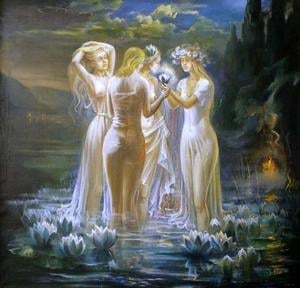 Our folk memory abounds with stories about samodives: in songs, in fairy tales. According to legends, nymphs or fairies are beautiful female creatures that inhabit forests. They have human form but superhuman abilities. They live in high mountain places, near clear springs or lakes. Self-divers come out in the summertime. Under their arms they have light wings, with the help of which they fly. The songs bear women's names. Samodivas live alone, without husbands and families. When it gets dark, they go to water - lakes, ponds, springs - they strip naked, bathe, wash their clothes and spread them out to dry in the moonlight, keeping a watchful eye so that no one steals them. Then they gather in the same meadow in the most distant dense forests, called a clearing, and play a barefoot magical dance all night long. They love music, especially kavala tunes, so they often kidnap shepherds and make them play for them. Self-diving animals are afraid of sunlight, so at daybreak they quickly leave the den and hide.
Sometimes they appear as working women, especially in the harvest, and assist the work of brides with children. In most cases, however, they are hostile to humans - they lock up the water sources, hunt down and kill the shepherds, because they devastate their pastures, kidnap beautiful maidens and brides, or cause them trouble out of envy and malice. Samodivas ride large (suri) deer. They fraternize with heroes and with men who have done them good - they become their patrons and even give birth to children from them, from whom grow up glorious heroes like Sekula the child. Krali Marko was nursed by a samodiva and Vida Bazdardjiika is his step-sister.
If any man succeeds in stealing her veil (so-called shadow), or shirt, or girdle/belt of the diva, she becomes a common woman and obeys him. Such a diva goes through a marriage ceremony, gives birth, but does not become a good mother and housewife, but uses every opportunity to get back what she stole and, accordingly, her freedom, abandoning her children. Sometimes samodivevas molest of their own volition, but they obsess over their beloved without a trace and torture him with their whims to death.
THE IMAGE OF THE INDEPENDENT, FREE WOMAN IN OCCULTISM AND ESOTERICISM
 According to esoteric and occult currents, these wise women were real. Gathered in themselves a lot of wisdom and knowledge, understanding of life and nature, they love freedom and creativity. Since they are initiated and at a higher level of development, with more abilities, they are quite naturally mythologized. In fact, they are priestesses, who have passed through the highest initiations, have taken the path of the wise, possess the power and put goodness as the basis of their lives. Occultists consider them to be priestesses of Atlantis, of the "Order of the Passage" at the Temple of Light. According to folk beliefs, wild animals personify the awakening of life - they come with the spring awakening of plants and animals and leave in autumn, with the winter dying of nature. According to esotericists, they come with the spring to pass on the knowledge learned in the School during the winter and at the end of autumn they return home to study.
Eng. Galya Madzharova, wife of esotericist Eng. Hristo Madzharov writes: "The priestesses of this order performed all the rites of passage - birth, maturation, union, menopause and the passage of the spirit into other dimensions. In addition, their duties also included responsibility for the well-being, balance and health of planet Earth". As employees of the "Order of the Passage", they had the task of preserving the knowledge of the School and taking care of the families entrusted to them, one of which is the Bulgarian. They were mothers or wives of the great rulers in our ancient history, or they were the beginning of the lineages of many peoples around the world. If they happened to live among humans, the samodives protected the healthy from disease and healed the sick. Plague did not enter the villages where Samodiva lived. They also taught women through their daily activities to preserve, protect and support their family. The symbols embroidered on clothes and woven into carpets and rugs are not accidental either. Even the most common activities of women's daily life such as cooking, cleaning, embroidering, spinning wool, weaving, knitting, etc. are part of the ancient priestly activities of the Samodivas.
In addition to the white shirt, according to legends, the multi-colored belt/girdle was also an indispensable part of the diva's outfit. The colors of the Samodiva belt are seven (a divine number, a symbol of the union between god and man). Each color has a different vibration that affects the bodies and souls of people and cultivates certain virtues:
- Red - the spirit of life, a symbol of love in nature. It inspires joy and gaiety, an expression of strength and energy.
- Orange - acts on a person's personal life, makes him an individual and a person. Increases self-esteem and pushes towards self-expression.
- Yellow - a symbol of the mind, but not of the feelings. Color of wisdom and knowledge. It affects our mental development.
- Green - symbolizes growth, fertility, abundance, material well-being.
- Blue - a symbol of a favorable environment for the spiritual life of a person. Color of truth, of faith and dreams, of harmony and beauty.
- Indigo (dark blue): It carries the qualities of the color blue, but here it symbolizes more firmness and resilience, stabilizes the psyche and heals the nervous system.
- Violet - suggests strength, humility, mercy, kindness, magnanimity, perfection. A symbol of power and might. It has to do with the will of man.
All of this is very reminiscent of the seven chakras in Buddhist religions. A gradation is noticed: the principle of LOVE in nature gives LIFE (red), after you have received life, you have built yourself as an INDIVIDUAL (orange), you have acquired WISDOM AND KNOWLEDGE (yellow), you can reap the ABUNDANT FRUITS AND MATERIAL WELFARE ( green). Then you will realize the TRUTH (blue) about the spiritual life of man and this will make you HARD AND RESISTANT (dark blue) and only then will you acquire the AUTHORITY AND POWER (violet) through humility, mercy, kindness, magnanimity. Then you become PERFECT.
THE IMAGE OF THE INDEPENDENT, FREE WOMAN IN CHRISTIANITY
 The image of the independent woman with a free spirit who does not obey anyone is embedded in some monotheistic religions. We are all more or less familiar with the image of Lilith, although official Christian doctrine does not mention anything about her. Lilith has been erased from all Christian holy books. The only place it is mentioned is in the above quoted text from the Book of the Prophet Isaiah. What in Bulgarian is veda, in English is Lilith. Accounts of her remain only in pagan and heretical documents. Her image crosses many religious beliefs and mythologies, but in general it boils down to the same thing - a rebellious and highly sexual woman, whom men fear more than Satan himself.
According to the legends, Jehovah created Lilith from dust just like Adam. Their appearance in the world is completely equal. However, she rebels against her husband and leaves him. He even has the audacity to say the unpronounceable name of God out loud. According to the Sepher Ben Sira, an apocryphal 11th-century collection of Kabbalistic texts, the conflict between Adam and Lilith arose because the husband insisted that his wife be beneath him during sex—the classic missionary position. Thus he seeks to impose his authority and superiority over her. However, she refuses because she considers herself his equal. Yet both are made of dust, and by the same almighty hand. So it flies into the air and never comes back. Then, to be sure, God turns one of Adam's ribs into a new, second wife: submissive and obedient. And from there follow many restrictions for women in the patriarchal society.
ARE THE AMAZONS INDEPENDENT?
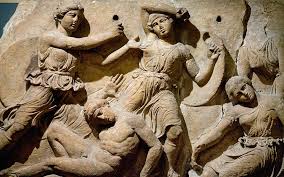 The Amazons of ancient Greek mythology are a warlike female tribe that we meet in many legends: in the Trojan cycle, in the so-called Amazonomachy and in some other myths related to heroes (for example, about Hercules and Hippolyta's girdle). They are described in the literature as isolated communities of warrior women who, at certain times of the year or at the appropriate time, enter into sexual relations with foreigners or with natives and after birth determine the fate of their offspring. The boys are sent to their fathers or killed, and the girls are brought up in a fighting spirit.
According to Academician Mishshi Yuhma from Chuvashia, there are traces of Amazons wherever Bulgarians lived. In his research, he tells about the Amazon Tamarislu, who in 530 BC. cut down the Persian king Cyrus because he encroached on her kingdom and killed her son. He also tells about the victories of the Amazons over the Tatar-Mongols in 1223. The Mongol general Subedei escaped and, through a bribe, found out when the Amazons performed love games in order to get pregnant. In the 9th month of pregnancy, he attacked them and thus destroyed the last Amazon communities near the Volga River.
Written records of Amazons near the Volga are also preserved in Arab annals. The writer Al Bakri describes the Amazons as racing on horseback, going into battle, and possessing courage and bravery. On a geographical map of 1459 by Ara-Mauro, the territory of Volga-Kam Bulgaria is marked as Amazonia. Vasyl Karazin (Ukrainian scientist, engineer, public figure, educator) recorded Chuvash tales about women's kingdom: "Then, when the earth, the sky, the people, the customs, and everything was different from now, there was a great khanate. There, the khan was a woman and the women did everything themselves: ruled, judged, fought, hunted."
And were there Amazons near the Danube? Written evidence is few, but there is a lot of information from the legends, rites and songs of our people. In the myths of the Thracian goddesses, a legend is preserved about the help that the Amazons give to the local inhabitants in purely female activities such as spinning and weaving, in the cultivation of plants and in the art of war.
In the epic "Veda Slovena", popular memory calls the Amazons Jews - heroic maidens, guardians of the Bulgarian people after Atlantis. The epic describes their 9-year training in all the sciences of "Heaven and Sun". Information about their abilities as sorceresses, healers, sisters, protectors of heroes has also survived in the songs and tales of samodivas.
In the historical chronicles there is information about the Amazonian origin of the Bulgarian woman. Documents prove that in the 7th century the Amazons were in the lands of Danube Bulgaria and Asparuh used them in the capture of Varna. Other legends and quite a few historical sources talk about the everyday life of the proto-Bulgarians - how they teach men's martial skills, such as horse riding, archery, etc., to children and women. In an anonymous Vatican account of the campaign of Nicephorus I and his defeat by Khan Krum on July 26, 811, it is noted that the Bulgarians armed the men and the women, who attacked the imperial detachment and killed them.
Ivaylo Ayanski, a chimney sweeper from the village of Stamatovo tells about his grandmother, a chimney sweeper. She told him that the secret of the Nestinar dances in their family was a legacy from her great-grandmother, who was a brave Amazon and protected the Bulgarians during the Ottoman invasion of the Rhodopes.
The historian Valcho Valchev tells a legend from the village of Bezmer. The sons of the great Canas Juvigi Kubrat: Kuber, Alcek and Asparuch were co-rulers of the Balkans (680) and had the task of guarding the eastern borders of Byzantium and therefore often roamed them. On the summer solstice around Spasovden, Asparuh and his retinue fell asleep near a spring in the area of Domuz Dere (2 km from today's village of Bezmer). Suddenly, from the darkness of the night, about 200 Amazon women approached, and from the other end of the meadow, as many young men who had been invited by the neighboring villages to an annual meeting. On Spasovden, the young people gathered around the spring, feasted, sang and danced, and after midnight, after the dew had fallen, the Amazons bathed in the spring in only their shirts and bare feet and conceived by the young men. And so it has been since time immemorial.
AT THE END…?
Whether she is a monster or a benefactor, whether she is a savage or an Amazon, the image of the independent woman with free will and spirit has been present since ancient times. And she must have existed in that form in which she was deified or demonized, as the antipode of the other woman - the human, the ordinary, the submissive and the subordinate. The past and legends are important so that we can make a connection between events and more clearly outline our way forward. And he is towards more and more perfection and elevation of our spirit towards pure love and goodness. Perhaps the image of the self-diva exists to show us that the way up lies in achieving a balance between the two extremes: unbridled voluptuousness and ultimate submission. Or not? Who knows…
© 2024 Iliana Dechkova
References:
- https://bg.m.wikipedia.org/wiki/Amazons/
- https://ezoterikabg.net/2019/07/24/bulgarkite-naslednichki-na-drevnite-amazonki/
- https://pedagogy.azbuki.bg/news/novini-2021/broj-34-2021/bozhestva-ili-demoni-sa-samodivite/
- https://phitoapimed.org/samodivskite-kolani/
- https://www.obekti.bg/misterii/lilit-prvata-zhena-na-adam-0?fbclid=IwZXh0bgNhZW0CMTAAAR2VTtK-egvL2NH-Q6VSscxhOG6HFJ_yzmSDv21i1ocADe5htMUUIJXwHko_aem_AYZUoNJG6K0mBLlujDzbI-LWMfDEQBXXD0x322VzQBpHhpUcTDIySZj1qX2T558kLCeCqdiFyWTbf2tGHHuDMXOt